Sponges are physically very distinct from other animals, and were long thought to have diverged first, representing the oldest animal phylum and forming a sister clade to all other animals.[133] Despite their morphological dissimilarity with all other animals, genetic evidence suggests sponges may be more closely related to other animals than the comb jellies are.[134][135] Sponges lack the complex organization found in most other animal phyla;[136] their cells are differentiated, but in most cases not organised into distinct tissues, unlike all other animals.[137] They typically feed by drawing in water through pores, filtering out small particles of food.[138]
The comb jellies and Cnidaria are radially symmetric and have digestive chambers with a single opening, which serves as both mouth and anus.[139] Animals in both phyla have distinct tissues, but these are not organised into discrete organs.[140] They are diploblastic, having only two main germ layers, ectoderm and endoderm.[141]
The tiny placozoans have no permanent digestive chamber and no symmetry; they superficially resemble amoebae.[142][143] Their phylogeny is poorly defined, and under active research.[134][144]
Idealised bilaterian body plan.[d] With an elongated body and a direction of movement the animal has head and tail ends. Sense organs and mouth form the basis of the head. Opposed circular and longitudinal muscles enable peristaltic motion.
The remaining animals, the great majority—comprising some 29 phyla and over a million species—form the Bilateriaclade, which have a bilaterally symmetric body plan. The Bilateria are triploblastic, with three well-developed germ layers, and their tissues form distinct organs. The digestive chamber has two openings, a mouth and an anus, and there is an internal body cavity, a coelom or pseudocoelom. These animals have a head end (anterior) and a tail end (posterior), a back (dorsal) surface and a belly (ventral) surface, and a left and a right side.[145][146]
Having a front end means that this part of the body encounters stimuli, such as food, favouring cephalisation, the development of a head with sense organs and a mouth. Many bilaterians have a combination of circular muscles that constrict the body, making it longer, and an opposing set of longitudinal muscles, that shorten the body;[146] these enable soft-bodied animals with a hydrostatic skeleton to move by peristalsis.[147] They also have a gut that extends through the basically cylindrical body from mouth to anus. Many bilaterian phyla have primary larvae which swim with cilia and have an apical organ containing sensory cells. However, over evolutionary time, descendant spaces have evolved which have lost one or more of each of these characteristics. For example, adult echinoderms are radially symmetric (unlike their larvae), while some parasitic worms have extremely simplified body structures.[145][146]
Genetic studies have considerably changed zoologists' understanding of the relationships within the Bilateria. Most appear to belong to two major lineages, the protostomes and the deuterostomes.[148] It is often suggested that the basalmost bilaterians are the Xenacoelomorpha, with all other bilaterians belonging to the subclade Nephrozoa.[149][150][151] However, this suggestion has been contested, with other studies finding that xenacoelomorphs are more closely related to Ambulacraria than to other bilaterians.[129]
The bilaterian gut develops in two ways. In many protostomes, the blastopore develops into the mouth, while in deuterostomes it becomes the anus.
Protostomes and deuterostomes differ in several ways. Early in development, deuterostome embryos undergo radial cleavage during cell division, while many protostomes (the Spiralia) undergo spiral cleavage.[152] Animals from both groups possess a complete digestive tract, but in protostomes the first opening of the embryonic gut develops into the mouth, and the anus forms secondarily. In deuterostomes, the anus forms first while the mouth develops secondarily.[153][154] Most protostomes have schizocoelous development, where cells simply fill in the interior of the gastrula to form the mesoderm. In deuterostomes, the mesoderm forms by enterocoelic pouching, through invagination of the endoderm.[155]
The Ecdysozoa are protostomes, named after their shared trait of ecdysis, growth by moulting.[162] They include the largest animal phylum, the Arthropoda, which contains insects, spiders, crabs, and their kin. All of these have a body divided into repeating segments, typically with paired appendages. Two smaller phyla, the Onychophora and Tardigrada, are close relatives of the arthropods and share these traits. The ecdysozoans also include the Nematoda or roundworms, perhaps the second largest animal phylum. Roundworms are typically microscopic and occur in nearly every environment where there is water;[163] some are important parasites.[164] Smaller phyla related to them are the Nematomorpha or horsehair worms, and the Kinorhyncha, Priapulida, and Loricifera. These groups have a reduced coelom, called a pseudocoelom.[165]
The Spiralia are a large group of protostomes that develop by spiral cleavage in the early embryo.[166] The Spiralia's phylogeny has been disputed, but it contains a large clade, the superphylum Lophotrochozoa, and smaller groups of phyla such as the Rouphozoa which includes the gastrotrichs and the flatworms. All of these are grouped as the Platytrochozoa, which has a sister group, the Gnathifera, which includes the rotifers.[167][168]
In the classical era, Aristotle divided animals,[e] based on his own observations, into those with blood (roughly, the vertebrates) and those without. The animals were then arranged on a scale from man (with blood, 2 legs, rational soul) down through the live-bearing tetrapods (with blood, 4 legs, sensitive soul) and other groups such as crustaceans (no blood, many legs, sensitive soul) down to spontaneously generating creatures like sponges (no blood, no legs, vegetable soul). Aristotle was uncertain whether sponges were animals, which in his system ought to have sensation, appetite, and locomotion, or plants, which did not: he knew that sponges could sense touch and would contract if about to be pulled off their rocks, but that they were rooted like plants and never moved about.[174]
In 1758, Carl Linnaeus created the first hierarchical classification in his Systema Naturae.[175] In his original scheme, the animals were one of three kingdoms, divided into the classes of Vermes, Insecta, Pisces, Amphibia, Aves, and Mammalia. Since then, the last four have all been subsumed into a single phylum, the Chordata, while his Insecta (which included the crustaceans and arachnids) and Vermes have been renamed or broken up. The process was begun in 1793 by Jean-Baptiste de Lamarck, who called the Vermes une espèce de chaos (a chaotic mess)[f] and split the group into three new phyla: worms, echinoderms, and polyps (which contained corals and jellyfish). By 1809, in his Philosophie Zoologique, Lamarck had created 9 phyla apart from vertebrates (where he still had 4 phyla: mammals, birds, reptiles, and fish) and molluscs, namely cirripedes, annelids, crustaceans, arachnids, insects, worms, radiates, polyps, and infusorians.[173]
In his 1817 Le Règne Animal, Georges Cuvier used comparative anatomy to group the animals into four embranchements ("branches" with different body plans, roughly corresponding to phyla), namely vertebrates, molluscs, articulated animals (arthropods and annelids), and zoophytes (radiata) (echinoderms, cnidaria and other forms).[177] This division into four was followed by the embryologist Karl Ernst von Baer in 1828, the zoologist Louis Agassiz in 1857, and the comparative anatomist Richard Owen in 1860.[178]
In 1874, Ernst Haeckel divided the animal kingdom into two subkingdoms: Metazoa (multicellular animals, with five phyla: coelenterates, echinoderms, articulates, molluscs, and vertebrates) and Protozoa (single-celled animals), including a sixth animal phylum, sponges.[179][178] The protozoa were later moved to the former kingdom Protista, leaving only the Metazoa as a synonym of Animalia.[180]
The human population exploits a large number of other animal species for food, both of domesticated livestock species in animal husbandry and, mainly at sea, by hunting wild species.[181][182] Marine fish of many species are caught commercially for food. A smaller number of species are farmed commercially.[181][183][184] Humans and their livestock make up more than 90% of the biomass of all terrestrial vertebrates, and almost as much as all insects combined.[185]
is the general appearance of an animal resulting from the reflection or emission of light from its surfaces. Some animals are brightly coloured, while others are hard to see. In some species, such as the peafowl, the male has strong patterns, conspicuous colours and is iridescent, while the female is far less visible.
There are several separate reasons why animals have evolved colours. Camouflage enables an animal to remain hidden from view. Animals use colour to advertise services such as cleaning to animals of other species; to signal their sexual status to other members of the same species; and in mimicry, taking advantage of the warning coloration of another species. Some animals use flashes of colour to divert attacks by startling predators. Zebras may possibly use motion dazzle, confusing a predator's attack by moving a bold pattern rapidly. Some animals are coloured for physical protection, with pigments in the skin to protect against sunburn, while some frogs can lighten or darken their skin for temperature regulation. Finally, animals can be coloured incidentally. For example, blood is red because the haem pigment needed to carry oxygen is red. Animals coloured in these ways can have striking natural patterns.
Animals produce colour in both direct and indirect ways. Direct production occurs through the presence of visible coloured cells known as pigment which are particles of coloured material such as freckles. Indirect production occurs by virtue of cells known as chromatophores which are pigment-containing cells such as hair follicles. The distribution of the pigment particles in the chromatophores can change under hormonal or neuronal control. For fishes it has been demonstrated that chromatophores may respond directly to environmental stimuli like visible light, UV-radiation, temperature, pH, chemicals, etc.[1] colour change helps individuals in becoming more or less visible and is important in agonistic displays and in camouflage. Some animals, including many butterflies and birds, have microscopic structures in scales, bristles or feathers which give them brilliant iridescent colours. Other animals including squid and some deep-sea fish can produce light, sometimes of different colours. Animals often use two or more of these mechanisms together to produce the colours and effects they need.
Further information: Coloration evidence for natural selection
Animal coloration has been a topic of interest and research in biology for centuries. In the classical era, Aristotle recorded that the octopus was able to change its coloration to match its background, and when it was alarmed.[2]
The parts of the Feathers of this glorious Bird appear, through the Microscope, no less gaudy then do the whole Feathers; for, as to the naked eye 'tis evident that the stem or quill of each Feather in the tail sends out multitudes of Lateral branches, ... so each of those threads in the Microscope appears a large long body, consisting of a multitude of bright reflecting parts. ... their upper sides seem to me to consist of a multitude of thin plated bodies, which are exceeding thin, and lie very close together, and thereby, like mother of Pearl shells, do not onely reflect a very brisk light, but tinge that light in a most curious manner; and by means of various positions, in respect of the light, they reflect back now one colour, and then another, and those most vividly. Now, that these colours are onely fantastical ones, that is, such as arise immediately from the refractions of the light, I found by this, that water wetting these colour'd parts, destroy'd their colours, which seem'd to proceed from the alteration of the reflection and refraction.
According to Charles Darwin's 1859 theory of natural selection, features such as coloration evolved by providing individual animals with a reproductive advantage. For example, individuals with slightly better camouflage than others of the same species would, on average, leave more offspring. In his Origin of Species, Darwin wrote:[4]
When we see leaf-eating insects green, and bark-feeders mottled-grey; the alpine ptarmigan white in winter, the red-grouse the colour of heather, and the black-grouse that of peaty earth, we must believe that these tints are of service to these birds and insects in preserving them from danger. Grouse, if not destroyed at some period of their lives, would increase in countless numbers; they are known to suffer largely from birds of prey; and hawks are guided by eyesight to their prey, so much so, that on parts of the Continent persons are warned not to keep white pigeons, as being the most liable to destruction. Hence I can see no reason to doubt that natural selection might be most effective in giving the proper colour to each kind of grouse, and in keeping that colour, when once acquired, true and constant.
Henry Walter Bates's 1863 book The Naturalist on the River Amazons describes his extensive studies of the insects in the Amazon basin, and especially the butterflies. He discovered that apparently similar butterflies often belonged to different families, with a harmless species mimicking a poisonous or bitter-tasting species to reduce its chance of being attacked by a predator, in the process now called after him, Batesian mimicry.[5]
Edward Bagnall Poulton's strongly Darwinian 1890 book The Colours of Animals, their meaning and use, especially considered in the case of insects argued the case for three aspects of animal coloration that are broadly accepted today but were controversial or wholly new at the time.[6][7] It strongly supported Darwin's theory of sexual selection, arguing that the obvious differences between male and female birds such as the argus pheasant were selected by the females, pointing out that bright male plumage was found only in species "which court by day".[8] The book introduced the concept of frequency-dependent selection, as when edible mimics are less frequent than the distasteful models whose colours and patterns they copy. In the book, Poulton also coined the term aposematism for warning coloration, which he identified in widely differing animal groups including mammals (such as the skunk), bees and wasps, beetles, and butterflies.[8]
Frank Evers Beddard's 1892 book, Animal Coloration, acknowledged that natural selection existed but examined its application to camouflage, mimicry and sexual selection very critically.[9][10] The book was in turn roundly criticised by Poulton.[11]
In Roseate Spoonbills 1905–1909, Abbott Handerson Thayer tried to show that even the bright pink of these conspicuous birds had a cryptic function.
Abbott Handerson Thayer's 1909 book Concealing-Coloration in the Animal Kingdom, completed by his son Gerald H. Thayer, argued correctly for the widespread use of crypsis among animals, and in particular described and explained countershading for the first time. However, the Thayers spoilt their case by arguing that camouflage was the sole purpose of animal coloration, which led them to claim that even the brilliant pink plumage of the flamingo or the roseate spoonbill was cryptic—against the momentarily pink sky at dawn or dusk. As a result, the book was mocked by critics including Theodore Roosevelt as having "pushed [the "doctrine" of concealing coloration] to such a fantastic extreme and to include such wild absurdities as to call for the application of common sense thereto."[12][13]
Hugh Bamford Cott's 500-page book Adaptive Coloration in Animals, published in wartime 1940, systematically described the principles of camouflage and mimicry. The book contains hundreds of examples, over a hundred photographs and Cott's own accurate and artistic drawings, and 27 pages of references. Cott focussed especially on "maximum disruptive contrast", the kind of patterning used in military camouflage such as disruptive pattern material. Indeed, Cott describes such applications:[14]
the effect of a disruptive pattern is to break up what is really a continuous surface into what appears to be a number of discontinuous surfaces... which contradict the shape of the body on which they are superimposed.
One of the pioneers of research into animal coloration, Edward Bagnall Poulton[8] classified the forms of protective coloration, in a way which is still helpful. He described: protective resemblance; aggressive resemblance; adventitious protection; and variable protective resemblance.[20] These are covered in turn below.
A camouflaged orange oak leaf butterfly, Kallima inachus (centre) has protective resemblance.
Protective resemblance is used by prey to avoid predation. It includes special protective resemblance, now called mimesis, where the whole animal looks like some other object, for example when a caterpillar resembles a twig or a bird dropping. In general protective resemblance, now called crypsis, the animal's texture blends with the background, for example when a moth's colour and pattern blend in with tree bark.[20]
Aggressive resemblance is used by predators or parasites. In special aggressive resemblance, the animal looks like something else, luring the prey or host to approach, for example when a flower mantis resembles a particular kind of flower, such as an orchid. In general aggressive resemblance, the predator or parasite blends in with the background, for example when a leopard is hard to see in long grass.[20]
For adventitious protection, an animal uses materials such as twigs, sand, or pieces of shell to conceal its outline, for example when a caddis fly larva builds a decorated case, or when a decorator crab decorates its back with seaweed, sponges and stones.[20]
In variable protective resemblance, an animal such as a chameleon, flatfish, squid or octopus changes its skin pattern and colour using special chromatophore cells to resemble whatever background it is currently resting on (as well as for signalling).[20]
The main mechanisms to create the resemblances described by Poulton – whether in nature or in military applications – are crypsis, blending into the background so as to become hard to see (this covers both special and general resemblance); disruptive patterning, using colour and pattern to break up the animal's outline, which relates mainly to general resemblance; mimesis, resembling other objects of no special interest to the observer, which relates to special resemblance; countershading, using graded colour to create the illusion of flatness, which relates mainly to general resemblance; and counterillumination, producing light to match the background, notably in some species of squid.[20]
Countershading was first described by the American artist Abbott Handerson Thayer, a pioneer in the theory of animal coloration. Thayer observed that whereas a painter takes a flat canvas and uses coloured paint to create the illusion of solidity by painting in shadows, animals such as deer are often darkest on their backs, becoming lighter towards the belly, creating (as zoologist Hugh Cott observed) the illusion of flatness,[21] and against a matching background, of invisibility. Thayer's observation "Animals are painted by Nature, darkest on those parts which tend to be most lighted by the sky's light, and vice versa" is called Thayer's Law.[22]
Colour is widely used for signalling in animals as diverse as birds and shrimps. Signalling encompasses at least three purposes:
advertising, to signal a capability or service to other animals, whether within a species or not
sexual selection, where members of one sex choose to mate with suitably coloured members of the other sex, thus driving the development of such colours
warning, to signal that an animal is harmful, for example can sting, is poisonous or is bitter-tasting. Warning signals may be mimicked truthfully or untruthfully.
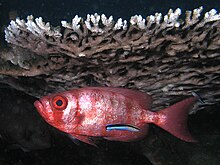
Advertising coloration can signal the services an animal offers to other animals. These may be of the same species, as in sexual selection, or of different species, as in cleaning symbiosis. Signals, which often combine colour and movement, may be understood by many different species; for example, the cleaning stations of the banded coral shrimp Stenopus hispidus are visited by different species of fish, and even by reptiles such as hawksbill sea turtles.[23][24][25]
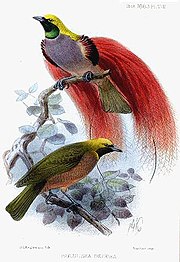
Darwin observed that the males of some species, such as birds-of-paradise, were very different from the females.
Darwin explained such male-female differences in his theory of sexual selection in his book The Descent of Man.[26] Once the females begin to select males according to any particular characteristic, such as a long tail or a coloured crest, that characteristic is emphasized more and more in the males. Eventually all the males will have the characteristics that the females are sexually selecting for, as only those males can reproduce. This mechanism is powerful enough to create features that are strongly disadvantageous to the males in other ways. For example, some male birds-of-paradise have wing or tail streamers that are so long that they impede flight, while their brilliant colours may make the males more vulnerable to predators. In the extreme, sexual selection may drive species to extinction, as has been argued for the enormous horns of the male Irish elk, which may have made it difficult for mature males to move and feed.[27]
Different forms of sexual selection are possible, including rivalry among males, and selection of females by males.
Warning coloration (aposematism) is effectively the "opposite" of camouflage, and a special case of advertising. Its function is to make the animal, for example a wasp or a coral snake, highly conspicuous to potential predators, so that it is noticed, remembered, and then avoided. As Peter Forbes observes, "Human warning signs employ the same colours – red, yellow, black, and white – that nature uses to advertise dangerous creatures."[28] Warning colours work by being associated by potential predators with something that makes the warning coloured animal unpleasant or dangerous.[29] This can be achieved in several ways, by being any combination of:
The black and yellow warning colours of the cinnabar moth caterpillar, Tyria jacobaeae, are avoided by some birds.
foul-smelling, for example the skunk can eject a liquid with a long-lasting and powerful odour[32]
aggressive and able to defend itself, for example honey badgers.[33]
venomous, for example a wasp can deliver a painful sting, while snakes like the viper or coral snake can deliver a fatal bite.[28]
Warning coloration can succeed either through inborn behaviour (instinct) on the part of potential predators,[34] or through a learned avoidance. Either can lead to various forms of mimicry. Experiments show that avoidance is learned in birds,[35]mammals,[36]lizards,[37] and amphibians,[38] but that some birds such as great tits have inborn avoidance of certain colours and patterns such as black and yellow stripes.[34]
The hawk-cuckoo resembles a predatory shikra, giving the cuckoo time to lay eggs in a songbird's nest unnoticed
Mimicry means that one species of animal resembles another species closely enough to deceive predators. To evolve, the mimicked species must have warning coloration, because appearing to be bitter-tasting or dangerous gives natural selection something to work on. Once a species has a slight, chance, resemblance to a warning coloured species, natural selection can drive its colours and patterns towards more perfect mimicry. There are numerous possible mechanisms, of which the best known are:
Batesian mimicry, where an edible species resembles a distasteful or dangerous species. This is most common in insects such as butterflies. A familiar example is the resemblance of harmless hoverflies (which have no sting) to bees.
Müllerian mimicry, where two or more distasteful or dangerous animal species resemble each other. This is most common among insects such as wasps and bees (hymenoptera).
Batesian mimicry was first described by the pioneering naturalist Henry W. Bates. When an edible prey animal comes to resemble, even slightly, a distasteful animal, natural selection favours those individuals that even very slightly better resemble the distasteful species. This is because even a small degree of protection reduces predation and increases the chance that an individual mimic will survive and reproduce. For example, many species of hoverfly are coloured black and yellow like bees, and are in consequence avoided by birds (and people).[5]
Müllerian mimicry was first described by the pioneering naturalist Fritz Müller. When a distasteful animal comes to resemble a more common distasteful animal, natural selection favours individuals that even very slightly better resemble the target. For example, many species of stinging wasp and bee are similarly coloured black and yellow. Müller's explanation of the mechanism for this was one of the first uses of mathematics in biology. He argued that a predator, such as a young bird, must attack at least one insect, say a wasp, to learn that the black and yellow colours mean a stinging insect. If bees were differently coloured, the young bird would have to attack one of them also. But when bees and wasps resemble each other, the young bird need only attack one from the whole group to learn to avoid all of them. So, fewer bees are attacked if they mimic wasps; the same applies to wasps that mimic bees. The result is mutual resemblance for mutual protection.[39]
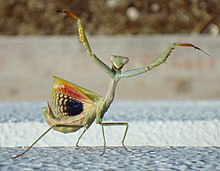
A praying mantis in deimatic or threat pose displays conspicuous patches of colour to startle potential predators. This is not warning coloration as the insect is palatable.
Some animals such as many moths, mantises and grasshoppers, have a repertoire of threatening or startling behaviour, such as suddenly displaying conspicuous eyespots or patches of bright and contrasting colours, so as to scare off or momentarily distract a predator. This gives the prey animal an opportunity to escape. The behaviour is deimatic (startling) rather than aposematic as these insects are palatable to predators, so the warning colours are a bluff, not an honest signal.[40][41]
Some prey animals such as zebra are marked with high-contrast patterns which possibly help to confuse their predators, such as lions, during a chase. The bold stripes of a herd of running zebra have been claimed make it difficult for predators to estimate the prey's speed and direction accurately, or to identify individual animals, giving the prey an improved chance of escape.[42] Since dazzle patterns (such as the zebra's stripes) make animals harder to catch when moving, but easier to detect when stationary, there is an evolutionary trade-off between dazzle and camouflage.[42] There is evidence that the zebra's stripes could provide some protection from flies and biting insects.[43]
Many animals have dark pigments such as melanin in their skin, eyes and fur to protect themselves against sunburn[44] (damage to living tissues caused by ultraviolet light).[45][46] Another example of photoprotective pigments are the GFP-like proteins in some corals.[47] In some jellyfish, rhizostomins have also been hypothesized to protect against ultraviolet damage.[48]
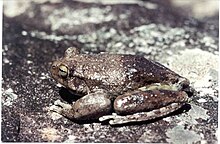
Some frogs such as Bokermannohyla alvarengai, which basks in sunlight, lighten their skin colour when hot (and darkens when cold), making their skin reflect more heat and so avoid overheating.[49]
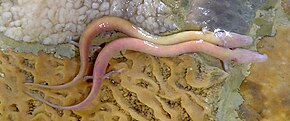
Some animals are coloured purely incidentally because their blood contains pigments. For example, amphibians like the olm that live in caves may be largely colorless as colour has no function in that environment, but they show some red because of the haem pigment in their red blood cells, needed to carry oxygen. They also have a little orange coloured riboflavin in their skin.[50] Human albinos and people with fair skin have a similar colour for the same reason.[51]
ANIMALS SPECICATION OF ANIMALS : Animals are multicellular, eukaryotic organisms in the biological kingdom Animalia (/ˌænɪˈmeɪliə/[4]). With few exceptions, animals consume organic material, breathe oxygen, have myocytes and are able to move, can reproduce sexually, and grow from a hollow sphere of cells, the blastula, during embryonic development. Animals form a clade, meaning that they arose from a single common APPERANCE OF THE ANIMALS WORLD : Over 1.5 million living animal species have been described, of which around 1.05 million are insects, ovmolluscs, and around 65,000 are vertebrates. It has been estimated there are as many as 7.77 million animal species on Earth. Animal body lengths range from 8.5 μm (0.00033 in) to 33.6 m (110 ft). They have complex ecologies and interactions with each other and their environments, forming intricate food webs. The scientific study of animals...
TAMILNADU BIRDS SANCTURY PLACESES Introductipon Melaselvanur-Kilaselvanur Bird Sanctuary Nanjarayan Bird Sanctuary Point Calimere Wildlife and Bird Sanctuar Geography History Flora Fauna Threats Cultural heritage Pulicat Lake Bird Sanctuary Viralimalai Bird Sanctuary Vettangudi Bird Sanctuary Vellode Bird Sanctuary Vellode Bird Sanctuary Udayamarthandapuram Bird Sanctuary Introductipon A sanctuary , in its original meaning, is a sacred place , such as a shrine , protected by ecclesiastical immunity. By the use of such places as a haven, by extension the term has come to be used for any place of safety. This secondary use can be categorized into human sanctuary, a safe place for people, such as a political sanctuary; and non-human sanctuary, such as an animal or plant sanctuary. Melaselvanur-Kilaselvanur Bird Sanctuary Melaselvanur-Kilaselvanur Bird Sanctuary Melaselvanur-Kilaselvanur Bir...
WILD LIFE SANCTUARY IN TAMIL NADU Introduction Wildlife Sanctuaries in Tamil Nadu Etymology History Geography Flora Fauna Tribal Communities Cauvery North Wildlife Sanctuary A wildlife sanctuary in India is a protected area of importance for flora , fauna , or features of geological or other interest, which is reserved and managed for conservation and to provide opportunities for study or research . The Wild Life (Protection) Act, 1972 provides for the establishment of protected areas in India. [ 1 ] Wildlife sanctuaries of India, are classified as IUCN Category IV protected areas . As of March 2025, 573 wildlife sanctuaries have been established, covering 123,762.56 km 2 (47,784.99 sq mi). [ 2 ] Among these, Project Tiger governs 53 tiger reserves , which are of special significance for the conservation of the Bengal tiger . [ 3 ] Additionally, there are 33 elephant reserves covering 80,778 km 2 (31,189 sq...


.JPG)









Comments
Post a Comment